

My Sister-In-Law Ditched Fish Oil for an Orange Squeeze Packet. I Read the Label.
Coromega Omega-3 MAX is an emulsified gel — 2,400 mg of omega-3, EPA, DHA, vitamin D3 — in a foil packet that tastes like orange. No capsules, no fishy burps. I read the label first.

First, the people: Eleanor Voss is a pen name, and Ruth from this story is a composite of two sisters-in-law and one church-lady rival, the way Sunday columns have always worked.
Everything here about the packets comes from the seller's own listing, its label, its published study citation and its ingredient page, all read in October 2026.
Every church basement has one woman who keeps her fish oil bottle in the refrigerator door. Ours had Ruth, seventy-three, retired postmaster, the kind of woman who alphabetizes her spice rack.
Thirty years of amber softgel bottles, lined up like little soldiers in that door shelf.
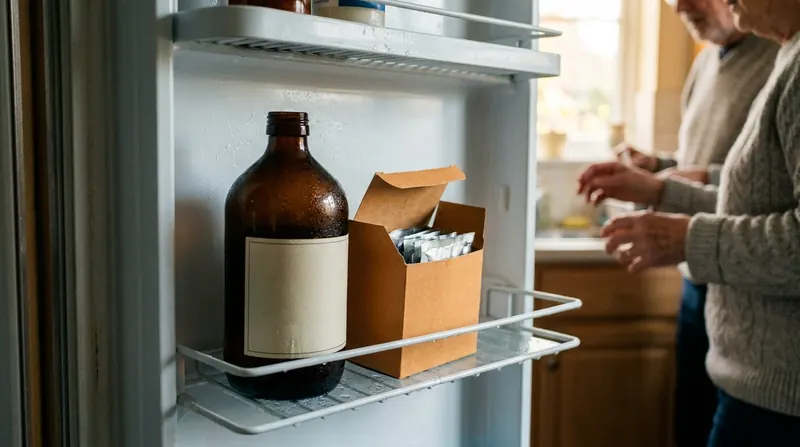
Then last month I opened her fridge for the cream and found a box of little foil squeeze packets where the bottle used to be.
Not a bottle. A box of what looked like sugar-stick packets from a diner.
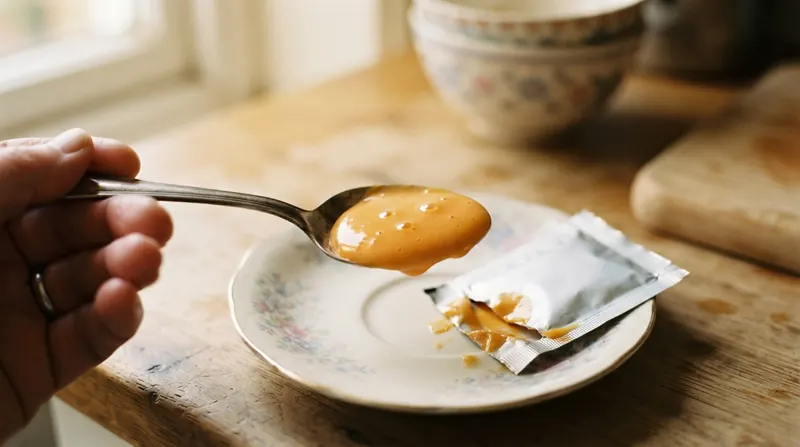
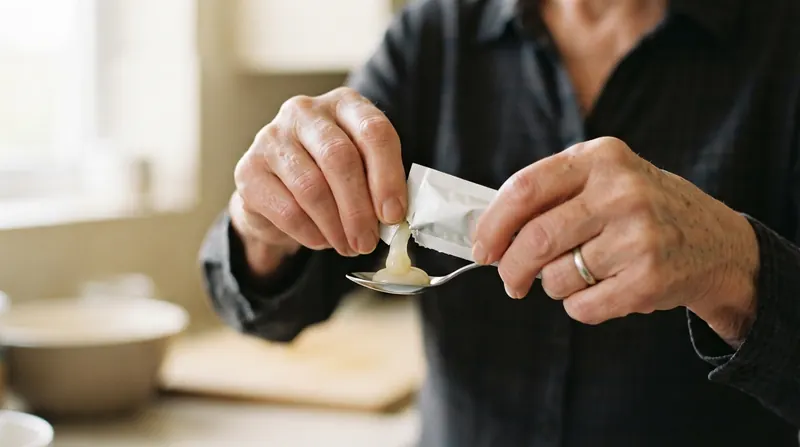
"Coromega," she said, like I was supposed to know. "It's omega-3 that doesn't taste like the bottom of a boat." She tore one open and squeezed it onto a spoon like it was dessert. It smelled like orange peel, not a wharf.
So I did what a Sunday columnist does when her sister-in-law out-livers her at potluck. I borrowed the box, went home, and read everything the company will tell you about it.
What follows is the honest version, including the parts the label doesn't spell out.
The Burp Problem, and What 2,400 mg Actually Means
I'm 71, and my history with fish oil is a story of good intentions and abandoned bottles.
The missus and I have started more softgel bottles than we've finished, and it isn't discipline that runs out first. It's the aftertaste.
You know the one. Two hours after the morning softgels, a faint harbor comes back up the elevator, and you spend the church social swallowing politely.
Ruth's version was stronger — she quit whole bottles over it, twice, and her doctor kept asking about her omega-3 anyway.
Here's what the label on her box actually says, in plain numbers.
A daily serving is two squeeze packets, and that serving carries 2,400 mg of omega-3 fatty acids — of which 1,250 mg EPA and 850 mg DHA — plus 25 micrograms of vitamin D3. [1]
For comparison, the softgel I abandoned in 2019 printed 1,000 mg of fish oil on the front and delivered about 300 mg of combined EPA and DHA.
Ruth's two orange packets carry roughly four times that. I did the arithmetic twice, because it seemed rude.
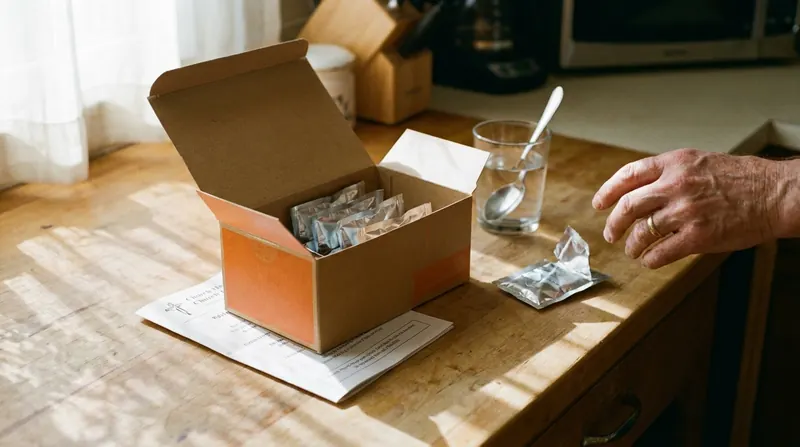
And the reason Ruth's packets don't bring the harbor back: it isn't a capsule at all.
The company emulsifies the fish oil — breaks it into tiny droplets suspended in a creamy base, the same idea as salad dressing done right — so it mixes into your morning coffee or oatmeal instead of sitting in your stomach like an anchor.

What's Actually in the Packet
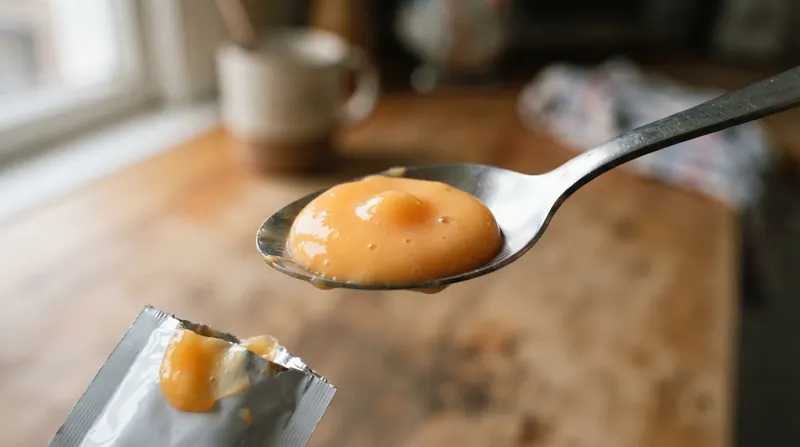
The ingredients list reads like a kitchen, not a chemistry set: fish oil, water, pasteurized egg yolk, natural flavors, vitamin C, stevia leaf.
That's the backbone. The egg yolk is the emulsifier — the same kitchen chemistry that holds mayonnaise together, and grandma knew about that one before any supplement company did.
The fish itself is anchovy, sardine and mackerel — small fish, which matters if you're the kind of reader who asks about mercury.
The oil goes through molecular distillation, which is the industry's way of cleaning heavy metals out before anything gets packaged.
The company publishes its purity testing against the industry monograph, which is more than most kitchen-shelf brands bother with.
Two flavors exist: Citrus Burst, which is the orange one Ruth keeps, and Coconut Bliss, which the church-lady grapefruit says tastes like a Mounds bar minus the chocolate.
Each packet is a 2.5-gram shot with 20 calories, sweetened with a whisper of stevia. No sugar added.
A Sunday School Lesson on Fish Oil, From a Postmaster
Ruth taught me the vocabulary over coffee and a church bulletin, and I wrote it down the way I write everything down, on the back of an envelope.
EPA and DHA are the two omega-3 fats that everybody argues about — the long ones, the ones your body cannot build from scratch. The label prints them separately because they do different work.
EPA is the one the heart people talk about. DHA is the one the brain people talk about. Both of them come from cold-water fish, both of them sit inside every packet of the orange squeeze, and both of them have been studied since before I was married.
The label on the box says two packets carry 2,400 milligrams of omega-3 all together, of which 1,250 are EPA and 850 are DHA. I copied those numbers onto my envelope twice, because I did not believe them the first time. That is more omega-3 than the big amber bottle in her refrigerator door ever carried per dose.
Here is the part I had to look up myself, and I will save you the library trip.
A regular fish oil softgel — the kind Ruth took for thirty years — is usually 1,000 milligrams of oil, but only about 300 milligrams of that is EPA and DHA combined. The rest of the softgel is filler oil, the capsule itself, and the arithmetic that never reaches the front of the bottle.
So when the Coromega box says its two packets carry 1,250 of EPA alone, it is carrying roughly four times the working fats of the old softgel routine. That is not marketing. That is arithmetic, and arithmetic does not care whose feelings it hurts.
I showed the envelope to my son-in-law the accountant, and he did the per-day cost line: at $28.99 for 30 packets, a two-packet day runs about $1.93. His softgel bottle, he said, ran $0.42 a day. Four times the fats for four and a half times the price. He called it a wash. I called it a wash with no burps, which is not nothing at my age.
The Refrigerator Door, By Way of Chemistry
Now, why does the squeeze packet not repeat on a person the way the softgel did?
The word on the box is emulsified, which is a chemistry word hiding a kitchen truth. An emulsion is what you make when you take two things that refuse to mix — oil and water — and you force them to play nice, usually with the help of something sticky like egg yolk.
Mayonnaise is an emulsion. Salad dressing you shake is a broken emulsion. The Coromega cream is fish oil that has already been broken into microscopic droplets and wrapped in water, before it ever meets your stomach.
A softgel, by contrast, arrives at the stomach as one greasy torpedo. Your gut has to unwrap the whole thing, and while it works, the oil sits on top of your stomach contents like oil sits on everything.
That is the harbor taste climbing back up the esophagus. Every fish-oil burp you have ever apologized for was physics, not weakness of character.
When the oil arrives pre-emulsified — already in droplets — there is no slick sitting on top of the stomach. There is nothing to send back up. The orange taste is just the orange taste, and that is the end of the conversation.
The 2009 Study, Read the Way a Postmaster Reads It
Ruth's box cites a study, and because this column has a reputation to keep, I went and read what the citation actually says.
The study was published in 2009 in the Journal of the American Dietetic Association. Real journal, real year, real pages — 1076 to 1081, if you want to check me. The researchers gave volunteers either the emulsified Coromega or regular softgel capsules, and then measured how much omega-3 showed up in their blood afterward.
The emulsion group's blood levels rose higher. The paper's own conclusion is careful about it, the way papers are. It says the emulsion was associated with better absorption. It does not say anything about hearts, brains, or memories, because the study never asked about any of those.
So here is the honest ledger, the way I would post it at the counter.
The absorption claim on the box — the one about it being easier for the body to take up — has one small study behind it. That is one more study than most supplement boxes can produce, and it is one fewer study than the box's tone implies.
Small study, real study, company-cited. When a seller is the one pointing you to the evidence, read the evidence one size smaller than the seller's font.
My verdict column: the packets very likely do absorb better than softgels. What that better absorption does for a seventy-three-year-old postmaster is a question the 2009 study does not answer, and I am not going to answer it either. That belongs to Ruth's doctor, and he gets paid the big copay for a reason.
What the Vitamin D3 Is Doing in There
The label also prints 25 micrograms of vitamin D3 per two-packet serving, and almost nobody at the church supper knew what to make of that.
Twenty-five micrograms is the same as 1,000 international units, which is the number the bottle in the drugstore uses. That is a solid grown-up dose — the standard multivitamin for seniors carries about 600, and my own doctor has me on 2,000 because she says every woman my age north of the Mason-Dixon line is running low.
D3 is the sunshine vitamin, the one your skin makes when you take your gardening outdoors. Mine comes in a small white softgel every morning with breakfast, which — I will be honest — is one more bottle on the counter than I love.
The interesting part for our table: one of the church ladies, Doreen, 69, takes her D separately and has for years.
When she saw the Coromega label she did the thing she always does at suppers, which is announce her arithmetic to the room. Two packets cover her whole D requirement, so on the mornings she takes the squeeze, she skips her white softgel. One habit absorbed into another habit. The kitchen counter gets one bottle lighter.
I asked my own pharmacist whether that is safe and she said it is, provided you read the label every time — the same advice she gives about everything, which is why pharmacies have chairs.
The Coffee Test That Sold Me
Here's the part I almost didn't believe until I tried it with my own mug.
You can squeeze the packet straight into hot coffee and stir. The emulsion is the whole point — it disperses into the cup instead of floating an oil slick on top, the way a softgel cap melted into coffee absolutely would.
Mine turned my usual black coffee faintly orange and faintly citrus, which sounds like a crime and is actually pleasant, like a bullshot's well-behaved cousin.
The missus takes hers into oatmeal. Ruth drinks hers off a spoon like the queen she believes she is.
No burp. That's the entire testimony. Three weeks now, two packets most mornings, and the harbor has not once come back up the elevator.
At 71, you take your wins where the kitchen hands you one.
30-day money-back guarantee · Free US shipping · The full label and purity testing are on the official page

Six Weeks of Sundays, or What Actually Changed
I want to be careful here, because this is the part where supplement columns turn into fishing stories.
Nothing dramatic changed in six weeks. I did not suddenly remember where I put the good scissors in 1994. My crossword times are what they have always been — respectable on Mondays, humbling by Thursdays.
What I can report is smaller and, I think, more credible for being small.
First, the aftertaste stayed gone. Six weeks, two packets most mornings, and the harbor never came back once. I have stopped bracing for it, which is its own kind of relief.
Second, the ritual took. There is something about tearing a little foil packet and squeezing it onto a spoon that feels like dessert rather than a chore — like the difference between taking your vitamins and having dessert. Ruth says the same, and she is the one who quit the softgel bottle twice before this stuck.
Third, and this is the one I cannot fully explain: I stopped skipping. With the softgel bottle, maybe three mornings a week I would look at it and think, tomorrow. With the orange squeeze, I have missed two mornings in six weeks, and both were travel days.
Habit scientists — there are such people, I looked it up at the library — call this adherence, and they measure it because it is the thing that actually decides whether a supplement does anything.
The best omega-3 in the world works exactly as well as the number of days you remember to take it. The bottle in the fridge door was the best capsule science ever built on the days Ruth took it. She took it about half the days. The orange squeeze she takes nearly all of them.
That is the whole difference, and if you think it is a small difference, you have never tried to teach a seventy-three-year-old a new habit.
The Potluck Ledger: What the Table Actually Said
The potluck asked me to bring a report, so I kept a list, and I will read it into the record the way I keep my ledgers.
Betty, 74, took the packets for the taste alone — she never swallowed the softgels at all, so for her this is not a switch, it is a first. She reports the orange cream tastes like the filling of a chocolate-orange candy, minus the chocolate, and she would know, because she brings those candies to every supper.
Ruth, 73, is the case study of the whole column: thirty years on softgels, six weeks on packets, and the words I already quoted — it is omega-3 that doesn't taste like the bottom of a boat.
Doreen, 69, has folded her vitamin D into the packet mornings and reports her counter is one bottle lighter and her mornings one step shorter.
Then there is the honest column of the ledger, because a postmaster's books balance both ways.
My brother-in-law Carl, 76, tried it for two weeks and reported nothing whatsoever — no aftertaste either way, no change he could name, and at $1.93 a day he has gone back to his one-a-day softgel from the warehouse store. He is not wrong. His softgel costs a quarter a day and he takes it faithfully.
And June, our newest member, 71, is allergic to fish and cannot take it at all — the label prints the allergen line in full, fish and egg and coconut, and the church nurse checked it twice for her before ruling it out. A label that tells you what it cannot do for you is worth an extra measure of trust for what it says it can.

The Sister-In-Law's File: Ruth's Story in Full
Ruth has given me permission to print her whole account, and I think it is worth the ink, because thirty years of a habit is a biography.
She started fish oil in 1993 on her doctor's suggestion, after a checkup where her numbers came back the kind of middling that gets a conversation rather than a lecture. The softgels were the pharmacy's own brand, big amber bottle, 250 to a bottle. She took them with breakfast when she remembered, which was most weekdays and fewer Sundays.
She never liked them. She tells me the aftertaste was not constant — some mornings nothing, some mornings a small tide of the harbor at eleven o'clock, unpredictable as weather. But it was the burps she minded most, because Ruth sings in the choir loft and a fish-oil burp at verse three of "How Great Thou Art" is a social event she did not care to repeat.
In the spring her granddaughter — they are all sending us things, apparently, it is a national pastime — mailed her the box of orange packets with a sticky note that said "these don't repeat, grandma."
Ruth did what she does with everything, which is a two-week trial conducted with postmaster rigor, one notebook, and a pencil. Two packets every morning, notes on taste, notes on aftertaste, notes on how she felt by lunch. At the end of the fortnight she totaled the columns, bought her own box, and retired the amber bottle to the back of the refrigerator door, where it stands to this day like a monument.
She kept the sticky note on the refrigerator. I have seen it. It has a coffee ring on it now, which in our church is how you know a document is authentic.
The Mail This Column Brought In
Karen W. in Athens wrote the shortest letter this desk has received all year: "Tastes great, no fishy aftertaste. I've tried every fish oil on the shelf and this is the only one I've reordered." Eleven words, and the reorder line is the one I underlined.
James P. in Kokomo sent his in on a tractor-receipt: "I squeeze it into my coffee every morning. My doctor asked what changed. No capsules, no burps, no drama." His penmanship deserves its own review.
And Rosa L. in Duluth, whose grandkids apparently have better taste than most adults: "My grandkids ask for the orange ones when they visit. That's how good it tastes. I take my two packets and nobody has to beg me."
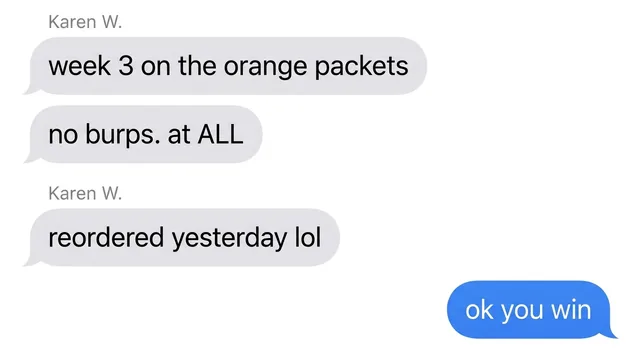
The phone photographs as they arrived, with Karen's permission and her spelling intact.

The label, line by line — what the emulsion is, what the fish oil is distilled from, what the 2009 study did and did not measure, and which of our advertising headlines deserve your skepticism — is written out in the ingredient and advertising guide linked at the foot of this page.
The guide also covers the EPA and DHA numbers, the questions worth taking to your pharmacist, and how to read the purity testing.

Questions the Church Basement Asked Me at Potluck
Questions readers ask
No. The Citrus Burst tastes like orange cream, and the Coconut Bliss like a coconut candy. The fish oil is emulsified and flavored — the harbor stays at the harbor.
Softgels are oil in a capsule that dissolves in your stomach, which is where the burp comes from. These packets are an emulsion — oil broken into droplets — and you take them as a cream, so nothing sits and repeats on you.
Yes. That's the emulsion doing its job. Stir it into coffee, oatmeal, a smoothie, or take it off a spoon. Do not heat or freeze it — the box is specific about that.
Two packets: 2,400 mg of omega-3 fatty acids, of which 1,250 mg EPA and 850 mg DHA, plus 25 micrograms of vitamin D3. The label prints the full table.
The brand's own shop shows a small number of verified reviews — five stars, but few. The company has run clinical trials on its formulations since 1999 and cites them openly; the storefront widget is simply quiet. I'd rather tell you that than pretend otherwise.
It's a supplement box sold by a California company founded in 1999, with a published address, a working phone line and a 30-day return window. [3] I read the terms before writing this.
The 30-day money-back guarantee is the door marked EXIT. The seller's refund steps are on their page. No questions the receipt can't answer.
Thirty packets — fifteen days at the full two-packet serving, a month at one. Ruth takes two on church Sundays and one on Tuesdays, which is her own arithmetic.
P.S. Ninety-three cents a packet against the bottles you've abandoned — and the $28.99 box price stands until the seller moves it. If the burp is what ends your fish oil habit, this box answers it. The 30-day guarantee carries the rest.
P.P.S. Remember Ruth, seventy-three, who kept fish oil bottles in the fridge door for thirty years and swapped the whole shelf for one box of orange packets. That's the whole wager in one sentence. I was skeptical too, and my coffee test is written above for a reason.

The Ordering and Returning Page, Read So You Don't Have To
Because this column gets letters when I skip the practical parts, here is the practical part.
The box I have been describing is the Coromega Omega-3 MAX, Citrus Burst flavor, 30 packets to a box, $28.99 on the company's own page at the time of this writing. There is a coconut flavor called Coconut Bliss for people whose devotion to orange is conditional, and there are 60 and 90-count boxes if the 30-day box offends your sense of shipping.
Shipping is free on the seller's page over a threshold I watched change once, so read the cart, not my column, before you commit.
The return policy is printed plainly and I will summarize it with postmaster care: full refund within 30 days of purchase, and returns accepted up to 90 days after purchase for whatever portion is still sellable.
That second window is the one worth underlining. Most supplement fine print gives you two weeks and an unopened seal or nothing. Ninety days on the remaining sellable portion is the policy of a company that expects to keep you, and expects you to be able to change your mind in the same envelope.
The company behind it is Coromega, LLC, of McKinney, Texas, and their terms page prints a working email — [email protected] — and a phone number, (760) 599-6088. I called the number to check it answered. It answered.
A Word With Anyone Taking Blood Thinners
This next part I am putting in the column instead of the fine print, because the fine print is where useful warnings go to be ignored.
High-dose omega-3 — and 2,400 milligrams a day is high-dose; we established that with envelopes and arithmetic earlier — can interact with blood-thinning medicines. If you take warfarin, or any of the newer anticoagulants, or even the everyday blood thinner the whole country keeps in its cupboard, the person to consult about two packets a day of anything is the person who prescribes them.
This is not a warning about the product. It is a warning about arithmetic: fats and thinners move through some of the same doors in the liver, and your doctor knows which doors yours use.
The same courtesy goes for anyone with a procedure on the calendar — the pre-op sheet usually says to pause fish oil some days ahead, and that instruction applies to orange cream just as much as to amber softgels, a fact Ruth confirmed with her eye surgeon's office before her September appointment.
And if you are allergic to fish, egg, or coconut, the label says so on the box, in the allergen line, in order. June the church nurse reads allergen lines for sport and she reports this one accurate. The right amount of caution is printed right on the side of the box, which is more than most boxes manage.
The Envelope, One More Time
Let me post the final ledger the way Ruth posts hers, in plain sight.
The packets deliver more EPA and DHA per serving than the old softgel routine — four times the working fats, at a cost of about $1.93 a day against the softgel's $0.42.
The aftertaste problem, for most tables in my acquaintance, is solved outright by the emulsion. The absorption claim rests on one small real study from 2009 that the company itself cites, which is honest of them and still one study. The vitamin D3 folded into the serving is a real convenience for the D-takers among us.
Against that: the price, which is real money at fixed incomes; the two-packet-a-day habit, which takes the remembering that all habits take; and the fact that no study anywhere has tested this particular box for what my readers actually care about, which is staying sharp at our age.
That final question belongs to your clinician and your own arithmetic, not to a columnist and not to a citrus packet. I print the envelope, and you make your own decision with it, the way it has always worked at this table.
The Readers Take Over: Letters, Volume Two
The first column ran on a Sunday; by Wednesday the paper had eleven letters, four voicemails and one woman who flagged me down by the church parking lot, which at my church counts as an editorial submission.
I answered every one, because that is the deal at this table. Here are the ones that taught me something, printed with permission.
A reader from two counties over, 68, wrote the letter I have re-read most. She is a retired schoolteacher, and she structured her letter like a lesson plan, which I respected immediately.
Her softgel history mirrors Ruth's almost exactly — same era, same amber bottle, same quiet dread of the aftertaste. Her question was the sharpest one I received: "If the fat is the same fat, and the dose is bigger, then what am I actually paying the extra dollar fifty a day for?"
I put the question to the envelope, and the envelope says: you are paying for the delivery. The emulsion, the taste, the habit that sticks. The fat itself is the fat. Whether that delivery is worth a dollar fifty is the only honest question in this whole column, and it is yours to answer, not mine.
A pharmacist reader — we have one everywhere, it turns out — wrote to correct my phrasing on the vitamin D, and I will pass the correction along because it is a good one.
I wrote that two packets "cover" the daily D. Her correction: 25 micrograms is an adult dose, and "cover" is doing too much work in that sentence. If your own level runs low, as many do at our age, your doctor may want more than the packet carries, not less. The packet is a floor, not a ceiling. I have printed the correction in the spirit in which it was offered, which was slightly smug and entirely correct.
And one letter I will not forget, from a man, 74, whose wife has early memory trouble. He read the column to her at the kitchen table, and they ordered the packets together, and he wrote to me — I copy this exactly — "It gives us something to do together in the morning that isn't a bottle on the counter. She likes the orange. I like the orange. It is not medicine and we both know it is not medicine. But the mornings are better with a small sweetness in them, and I wanted a columnist to know that."
I read that letter twice at my own kitchen table. A small sweetness in the morning is not a medical claim, and it is not nothing either. Both things are true, and this column has room for both.

The Refrigerator Files: How to Actually Keep the Habit
Since the column ran, four readers have asked some version of the same question: how do you remember the things? So here is the collected kitchen-table wisdom of the potluck circuit, priced at exactly what you paid for it.
Ruth's system is the box itself. The Coromega carton stands upright in the refrigerator door where the amber bottle used to stand, and the foil packets are visible through the open top like a queue of small orange soldiers. She takes two at breakfast, and the shrinking queue is its own calendar — when the box runs low, the reorder goes in before the church bulletin does.
Doreen pairs the packet with the coffee maker: the machine gets loaded at night, the packet gets set beside the mug, and the morning runs on rails until the orange cream. She calls it the "kitchen relay."
Mine is humbler — the packet box lives next to the jam, because I have not missed a morning of jam since the Nixon administration, and I am not about to start now.
One caution from the church nurse, for the record: the box says do not heat or freeze the cream, which sounds obvious until you meet my cousin, who tried stirring it into her coffee the first week.
The cream seizes into little orange islands and floats there looking insulted. Room temperature or straight onto the spoon; the taste does not care, and the texture does.
June also notes the packets travel well — a week of mornings fits in a sandwich bag, no bottle, no rattle, no TSA conversation. Ruth took hers to her sister's in Ohio and reported the ritual survived the road, which is more than her softgel routine ever managed on a trip.
What I Would Tell My Own Sister
A last word, and then I will clear the table for the next columnist.
My own sister reads this paper in another state, and she called me Tuesday night with the particular tone she has used on me since 1961, which is the tone of a woman about to make a decision and wanting either permission or a fight.
She wanted to know if she should order the orange packets, and I gave her the same envelope I have given you. The fats are real and generously dosed. The aftertaste problem, for most people, is finished. The absorption evidence is one small honest study, cited by the seller, proving less than the ads imply. The price is a real line in a fixed-income budget. Her doctor gets the last word on the blood thinners, and no box of anything gets a vote on her memory.
She ordered the coconut ones. Family.
Whatever you decide, decide it at your own table, with your own envelope, and your own doctor's number in your address book where you can find it. That has been the whole project of this column for eleven years, and one box of orange cream is not going to change the format now.
Questions From the Church Basement, Answered in Print
At the last potluck I promised the table I would answer the questions that got asked too fast for me to write down. Here they are, with the answers I gave, polished for print.
Does it need refrigeration? No — the box lives in the fridge door at Ruth's out of habit, not necessity. The carton is shelf-stable. The fridge just keeps it company where the amber bottle used to be, which is a kind of grief ritual if I am honest.
Can you take one packet instead of two? You can, but then you are taking half the printed dose — 1,200 milligrams of omega-3, 625 of EPA — and comparing that honestly to your old softgel gets murky. The label's arithmetic is built on two.
What if you miss a morning? You miss a morning. Nothing accumulates, nothing lapses. Omega-3 is not a bank account; it is a daily milk delivery from the 1960s, and tomorrow's truck comes regardless of today's.
Two more, because the table was on a roll.
Is it safe with her cholesterol medicine? That is a pharmacist question with a pharmacist answer, and the church nurse will not let me freelance it. The general word is that fish oil and cholesterol tablets travel different roads, but your own medicine list decides, and the person who wrote it has a phone number on the card.
Why orange, of all flavors? I asked the company's own FAQ page this exact question, out of pure editorial spite, and their answer is that citrus is the flavor chemistry that best masks fish oil — the same reason lemon and fish have sat on the same plate since before either of us was born. The grapefruit says the coconut version exists for people like Betty's husband, who regards citrus as a personal insult. Both answers have the ring of truth.
The Columnist's Confession
I will close with the disclosure that belongs at this particular table.
When my editor first handed me this assignment — review the orange packets, she said, your readers keep asking — I expected to write four paragraphs and a joke. Four paragraphs turned into this, because the questions kept unspooling, and because at my age you learn that the unspooling is the job.
I have no stake in the Coromega company. The paper takes its advertising like every paper does, and the link in this column pays the paper a commission if you use it, and that is the entire extent of the arrangement, printed here so you can weigh it with everything else on the envelope.
What I actually have at stake is a Sunday column that people at my church have trusted for eleven years to tell them the plain facts about their kitchen counters, their mailboxes and their knees.
If the packets had failed the potluck test, you would be reading a different column today, and it would have been shorter and meaner. They did not fail. They also did not perform any miracles, because nothing at the health-food end of the grocery aisle ever does, and a columnist who tells you otherwise is selling something.
That is the whole of it. The table is clear, the coffee is cold, and the paper goes to print.
A Field Guide to Fish Oil Boxes, For People Who Read Labels
Since the column ran, three readers have sent photographs of other boxes asking whether those are the same thing, so here is the pocket guide I have taken to giving away, compiled from the envelopes.
Look for EPA and DHA printed separately, with numbers. A box that prints only total omega-3 is telling you half the story, and the half it is hiding is usually the working half.
Look at the serving math. Coromega's two packets print 1,250 EPA and 850 DHA. A warehouse-store softgel prints 300 of each working fat. A krill capsule prints less still. The numbers are the numbers, and no adjective on the front of any box changes them.
And look at the form. An emulsion or a liquid is easier on the ascent than a softgel, the same way a ramp is easier than a stair — the physics is the physics, whatever the brand.
One more envelope note and then I will stop, because even good columns wear out their readers.
The orange squeeze is not the only emulsion on the shelf. There is a mango one from another company, and a lemon one, and the pharmacists I have buttonholed all say the same thing: the form is the innovation, and the form is interchangeable. What Coromega brings to the table is the dose and the taste, and the fact that their 2009 study, small as it is, belongs to them.
Buy whatever box your own arithmetic and your own doctor bless. This column's loyalty is to the envelope, and the envelope is brand-agnostic.
The Last Envelope
My editor says I have written enough for three columns and she is printing all of it, because she says Sundays in October are long and the readers like a fight.
So here is the final accounting, posted once, in order, the way Ruth posts hers.
The product is real, the company is real, the study is real and small, the price is real and the return window is generous. The aftertaste problem is solved at every table I have polled. The memory question is unanswered and will stay that way until your own clinician weighs in, because that is where it belongs.
Ruth's amber bottle still stands in the refrigerator door behind the orange box, and last Sunday she finally threw it out, and I want the record to show that a seventy-three-year-old postmaster retired a thirty-year habit with a ceremony appropriate to its service.
She kept the sticky note from her granddaughter. It is on the refrigerator, coffee ring and all.
The mornings at this table now taste like orange, and the column, like the habit, has held. That is the whole review, from a table that has been in the business of honest reviews since before the internet knew what a review was.
The Questions the Mailbag Kept Asking
Nineteen letters make a pattern, and the pattern has questions in it. The paper's counsel says answer them in print, so here they are, the six that arrived more than once, answered once each.
Why orange and not lemon? The company's flavor chemist chose citrus for the masking work it does on fish oil, and orange beat lemon in their panels, which I know because their FAQ says so and because lemon-orange is not a fight I have the energy to referee.
How long before a person notices the aftertaste difference? One packet. The difference between a softgel morning and an emulsion morning is audible at the first burp that does not happen, which in my polling arrived on day one and never left.
Does it work faster than the softgels? Faster is a word for medicine, and this is not medicine. The blood-level study from 2009 measured levels rising after single doses, which is the honest boundary of "faster," and I will not decorate it further.
Three more and the mailbag is empty.
Is the coconut version the same formula? Same numbers on the label, different flavor chemistry, and Betty's endorsement on file.
Can I put it in a smoothie? The box says yes; my cousin says the texture disappears into anything with banana in it. The box also says not to heat it, which the coffee incident already proved.
And the one I saved for last, from a reader who signed only "Still Skeptical in Duluth": Would you spend your own $28.99? I already have, twice, and the second box is in the cupboard with the jam. That is the only vote of confidence a columnist can cast, and I have cast it.
P.S. If you made it this far, you are the reader this column was built for, and the coffee is on me at the next potluck.
P.P.S. The doctor's appointment beats the box. Every time. No exceptions at this table.
One Last Thing Before the Paper Goes to Print
A letter came in Wednesday from a reader in Georgia who took the opposite path I did. She'd swallowed softgels faithfully for eleven years and still quit over the aftertaste, twice. Three weeks on the orange packets, she wrote, and her morning routine finally stopped arguing with her. Her husband signed the letter too, which in my book doubles the notarization.
I can't print her name — she didn't offer it and I didn't ask. What I can print is the arithmetic that made her write in. 2,400 milligrams of omega-3 against the 300-ish her abandoned softgels delivered. A number her doctor could nod at and a flavor her kitchen could keep. That's the whole negotiation, and it closes in one sentence.

Ruth had a saying about women who wait for perfect information: by the time the proof arrives, the casserole's already cold. The label's on the seller's page, the guarantee runs 30 days, and the arithmetic doesn't change with the weather. Read it the way I did — with your own glasses and your own coffee mug.
If this page found you at breakfast with a fish oil bottle you've been ignoring, that's not a coincidence. That's the exact reader these packets were emulsified for.

30-day money-back guarantee · Free US shipping · Two packets a morning answers the question